Oil Cooler Sizing: Rows, Lines & Thermostats
An oil cooler is one of the few mods where buying the wrong one is worse than buying nothing — a trans-rated cooler on an engine-oil circuit bleeds oil pressure and can starve bearings. Here's how to size one like you know what you're doing, and how to read a supplier's kit listing without getting burned.
Do you even need an oil cooler?
Honest first question. Most street cars don't. Oil needs to reach operating temp to work — that's why the thermostat exists. You need an auxiliary oil cooler when oil temps are actually beating the stock setup:
- Track days / back-to-back pulls. Sustained high rpm is where oil temps climb and stay. Engine oil routinely runs 240–320°F under hard use — if your car sees that regularly, you have a cooling problem worth solving.
- Tuned turbo cars. Turbos push oil temps hard. A tuned turbo car at the same power as an NA car needs more cooling — the turbo is a second heat source the factory cooler wasn't sized for.
- Hot climates + hard driving. Ambient heat stacks on top of everything else.
A daily driver that never sees a track and never logs scary oil temps doesn't need a cooler — it needs its oil changed on time. Instrument first: if you don't know your oil temps, you don't know whether you have a problem. A data-logger answer beats a guess every time.
Row count — the sizing ladder
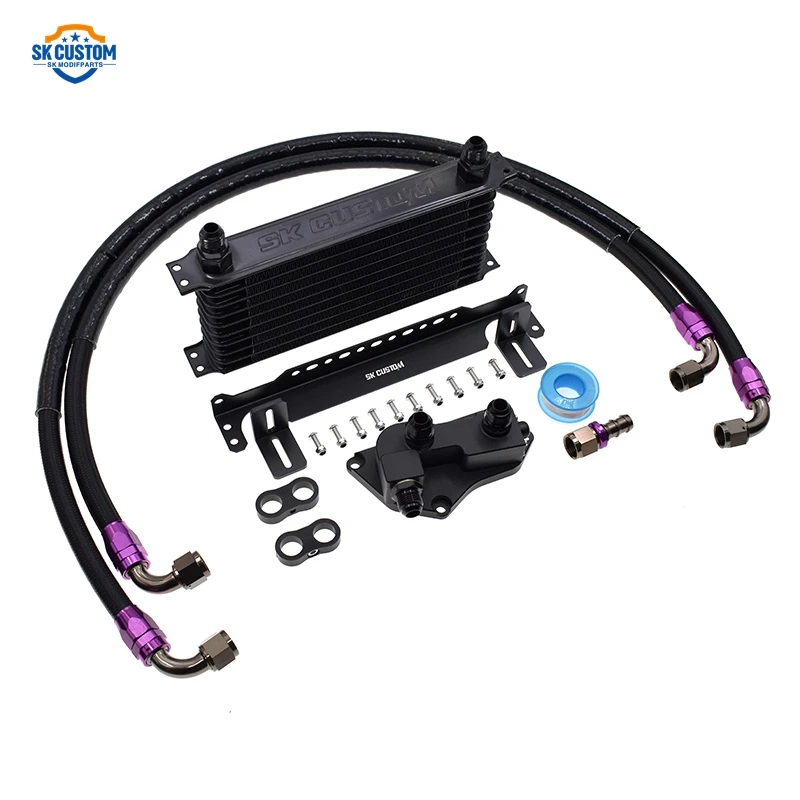
Stacked-plate coolers are sold by row count, and capacity roughly scales with rows. This is a community rule of thumb from track forums (clubgti/Club GTI lineage), not a lab spec — but it's the working ladder builders actually use:
- ~13 rows ≈ 150bhp on track, ~200bhp on road in good airflow. That's the baseline reference point.
- Tuned turbo? Go bigger. Same power, more heat — a tuned turbo car needs more cooler than the NA version of the same ladder.
- Airflow matters as much as rows. A big core starved of air underperforms a smaller one fed properly. Mounting location is part of the sizing decision.
Capacity figures from aggregated universal-kit spec tables: 7-row ≈ 0.13L, 10-row ≈ 0.19L, 13-row ≈ 0.24L, 16-row ≈ 0.30L, 19-row ≈ 0.35L, 25-row ≈ 0.47L, 30-row ≈ 0.56L. (Koyorad's own drawn-cup line runs a similar curve — 10-row/0.28qt up to 35-row/0.97qt — same shape, better core.)
-10AN is the engine-oil floor
This is the spec that separates an engine-oil kit from a plumbing kit that happens to contain a cooler. One well-quoted GolfMK7 track thread puts it plainly: a ~9-10-row Setrab-equivalent is rated around 130hp in ideal conditions and ~90hp in real road-car conditions, with roughly 5psi of pressure drop across the core alone — and -10AN lines cut that drop to roughly half of what -8AN costs you.
The reason is the 10psi-per-1000rpm rule — 70psi at 7000rpm. Hot thin oil already drops pressure on its own, so every psi you lose in undersized lines comes straight out of your bearing's safety margin. On track, that's not theoretical.
The transmission-cooler mix-up — read this before you buy "universal"
Alibaba "universal oil cooler kit" listings sell one cooler for "engine, transmission, and differential." That's a marketing line, not an engineering one — and it's the most dangerous confusion in this whole category:
- Different fluids, different worlds. Transmissions (ATF) start dying above ~195°F; engine oil routinely runs 240–320°F. A cooler sized for a transmission is UNDERBUILT for engine oil — small plate count, lower pressure tolerance.
- Different pressures. ATF circuits run at much lower pressure than engine oil. One turbobricks builder measured ~50psi of pressure drop across an air-to-air trans cooler plumbed into an engine-oil circuit at low revs. That's a bearing starvation setup, not a cooler.
- Correct ATF practice is different: an external trans cooler goes in line AFTER the radiator's built-in cooler, so the radiator brings ATF down first and the aux cooler finishes the job — transmissions also need to reach operating temp, and in-radiator routing handles that.
- Manual transmissions and diffs have NO pump. "Bolt-on cooler kits" for them are fiction without adding an external pump. The honest answer: instrument temps first — the vast majority of street and track manual cars never need it.
The thermostat — your first cooling mod
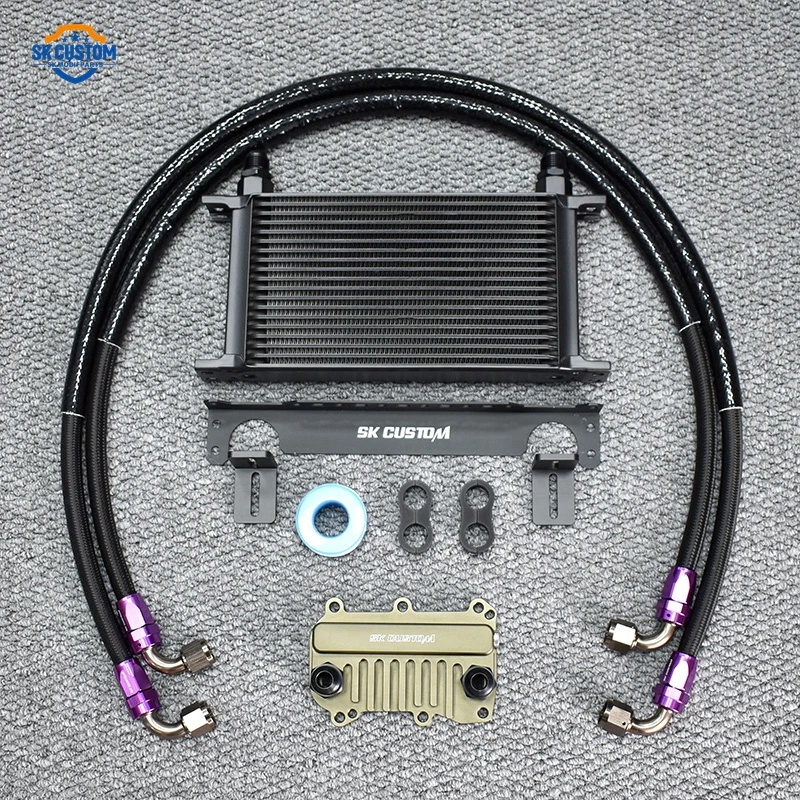
Here's the move most buyers skip: before you buy a cooler, check your thermostat. Stock BMW oil thermostats open around 120°C — that's high. Aftermarket low-temp thermostats drop operating temps without a full cooler kit:
- Improved Racing 180°F (82°C) oil-cooler adapter — N20/N54/N55/S55, fixes the factory adapter's restrictive flow valve.
- Mosselman thermostat — opens 85°C, holds 95–105°C, CNC aluminum (E8x/E9x kits).
- MMX Performance — holds 90–110°C (2008+ models).
A low-temp thermostat runs well under the cost of a full cooler kit and is the correct first step when oil temps are merely elevated rather than out of control. If you do buy the full kit, the sandwich plate must be THERMOSTATIC — a plain pass-through adapter flows oil through the cooler from a cold start, over-cooling the oil on street drives and delaying warmup. Thermostatic plates bypass the cooler until the oil is actually hot, which is the entire point of having a thermostat.
Pressure rating is a vetting check
Generic universal kits list test pressure around 116psi and burst around 232psi. That's transmission-duty territory. An engine-oil cooler sees real oil pressure plus heat — if a listing's pressure spec is weak or absent, that's a flag. Ask the supplier for the rated WORKING pressure (not just burst) before you treat any kit as engine-oil duty. A supplier that can't answer that question is telling you they don't engineer the kit — they assemble it.
When you need airflow: fans
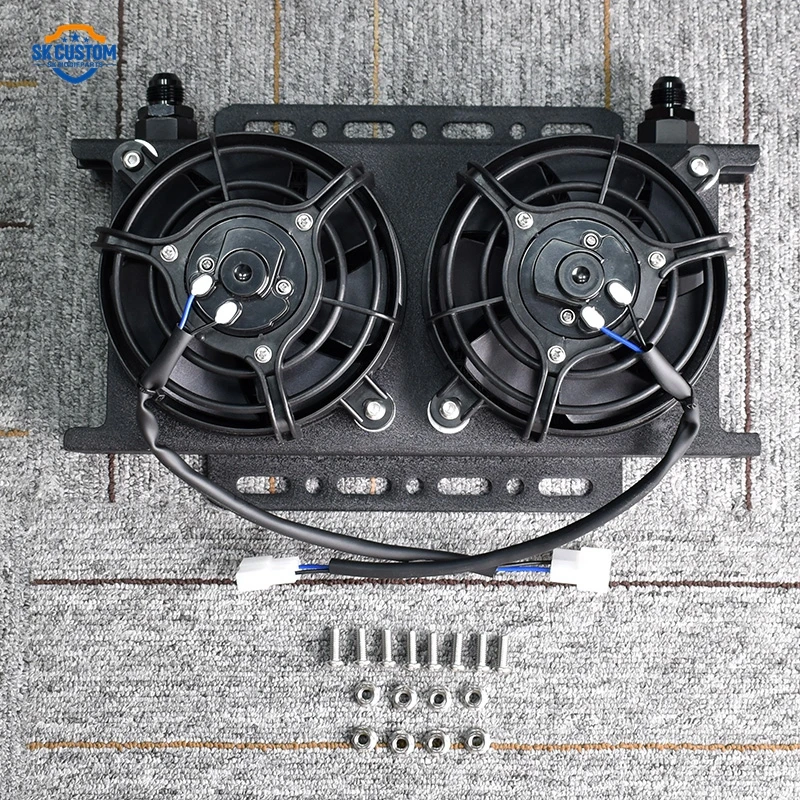
Track cars get airflow for free at speed; street cars and drift cars don't. If your oil temps spike in traffic or between runs, a fan-assisted setup is the answer — but ask whether the fan is rated for underhood temps. A fan that melts at 120°C ambient is decoration.
Supplier scripts — copy, paste, send
Pressure rating:
"What is the rated WORKING pressure of this cooler core — not burst, working pressure? Is it rated for engine-oil duty at full operating temperature?"
Thermostat:
"Is the sandwich plate thermostatic or a plain pass-through adapter? At what temperature does it open?"
Kit contents:
"What's in the box beyond the core — lines, fittings, brackets? What AN size are the lines and fittings?"
Filter adapter fitment:
"What thread are the filter adapters — 3/4\"-16 or M20x1.5? Confirm fitment for my [year] [make] [model] [engine code]."
Fan (if applicable):
"Is the fan rated for underhood temperatures? What is its operating temp range?"
Red flags
- "Fits engine, transmission, and differential." One cooler for three fluid circuits with different temps and pressures. See the mix-up section above.
- No pressure spec — or a weak one. ~116psi test / ~232psi burst is transmission-duty. Engine-oil duty needs the supplier to say so in writing.
- No thermostat, or a plain adapter. Over-cools on the street, delays warmup, wears the engine faster.
- -8AN lines or unmarked line size. -10AN is the engine-oil floor. Unmarked means ask before you buy.
- Cross-listed engine codes. A cooler kit is plumbing — the sandwich plate and adapters are engine-specific. If the listing fits "everything," the fitment verification is on you.
- "Bolt-on cooler" for a manual trans or diff with no pump. Fiction without an external pump. Instrument temps first.
Get the verified oil cooler suppliers
Everything above is the knowledge. The shortcut is the catalog: search "oil cooler kit with thermostat" in the Parts Plug vault for supplier-verified listings with real photos, ratings, and transaction history — the same factories, same quality, without the brand tax.
Parts Plug is $1.99/month ($19.90/year) — less than a sandwich plate gasket.
Search the vault → partsplugvault.com/parts