Forged wheels direct from the factory: what they actually cost
A set of brand-name forged wheels can run $4,000 or more. The same forged wheels leave the factory for a fraction of that — commonly $280 to $1,400 a set. This guide covers the real pricing, the construction types, the alloy grades, the fitment numbers you must get right, and how to buy direct without getting burned.
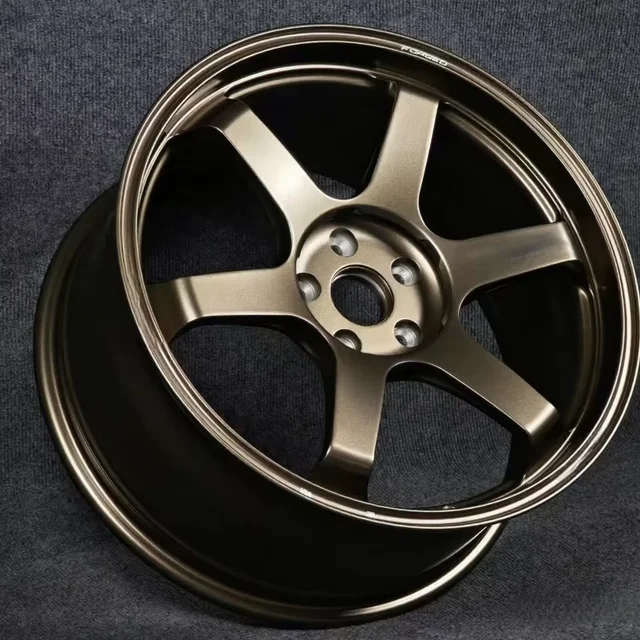
What forged wheels really cost
Forged wheels are made by pressing a solid billet of aluminum under extreme force — the grain structure compresses and aligns, and that's where the strength comes from. The process isn't cheap, but it's nowhere near brand retail. Direct from the factory, a set commonly lands between $280 and $1,400 depending on diameter, construction, and finish. Under a brand, the identical wheel is marked up to $4,000+. Same forging, same factory — the brand just adds a logo and a zero.
| Type | Factory-direct (set) | Brand retail |
|---|---|---|
| Monoblock forged | ~$280–$900 | $2,800+ |
| 2-piece forged | ~$700–$1,200 | $3,500+ |
| 3-piece forged | ~$900–$1,400 | $4,000+ |
Not every build needs forged, though. Cast and flow-formed wheels cost less and suit plenty of street cars — see how the three stack up in our flow-formed vs cast guide.
Forged vs flow-formed vs cast — the real hierarchy
Forget marketing words. There are three ways to make a wheel, and the difference is how the metal gets its strength:
- Forged (monoblock or multi-piece) — a solid cylinder of aluminum pressed under roughly 10,000 tons. Strongest, lightest, most expensive.
- Flow-formed — a cast blank spun while rollers stretch and compress the barrel. Better than plain cast, not as good as forged. The honest middle ground — great value for street cars.
- Cast — molten aluminum poured into a mold. Cheapest, heaviest, weakest of the three. Fine for daily driving at the rated load — not what you put on a track car.
Monoblock vs 2-piece vs 3-piece
- Monoblock — one forged piece. Lightest, best value, fewer custom options.
- 2-piece — forged face bolted to a barrel. More custom width and offset options.
- 3-piece — face, inner and outer barrel. Most customizable and rebuildable, but heavier and pricier.
6061-T6 vs 7075-T6 — the spec-sheet trap
This is the one that separates people who know wheels from people who read brochures. 6061-T6 is the honest standard for forged wheels: good strength, excellent corrosion resistance (road salt is real), and it can be welded and repaired. Every serious forged-wheel maker uses it for a reason — a wheel is a fatigue-and-corrosion part, not a pure strength part. It survives potholes year after year.
7075-T6 is about 84% stronger on paper. Here's the catch: it's worse at resisting corrosion without coating, and you basically can't weld-repair it — it cracks. A bent 7075 barrel is scrap. A bent 6061 barrel can often be fixed. When a supplier brags "7075 — stronger than 6061!" without mentioning coating or corrosion, they're selling you a spec sheet, not a wheel. 7075 only makes sense as a coated, track-only piece. Full breakdown in our wheel metallurgy guide.
The fitment numbers that matter
Ordering wheels direct from a factory means you are the one who has to get fitment right. Custom wheels are often made to order and hard to return. Six numbers, that's it:
| Spec | What it means |
|---|---|
| Bolt pattern (PCD) | Number of lugs and circle diameter, e.g. 5x112 or 5x114.3. Must match your hub exactly. |
| Offset (ET) | Distance from the wheel centerline to the mounting face, in mm. Higher offset = wheel sits further in. |
| Width & diameter | E.g. 19x9.5. Affects tire size, rubbing, and brake clearance. |
| Center bore | The hole that locates the wheel on the hub. Too big needs hub-centric rings; too small will not fit. |
| Load rating | How much weight each wheel is rated to carry. Matters for heavy cars, SUVs and trucks. |
| Seat type | Conical, ball or flat lug seat. Must match your lug nuts or bolts. |
Check your owner's manual or a reputable fitment database for your exact year and trim. Look inside your current wheel — offset and size are usually stamped there. Check your brake calipers — big brake kits need more spoke clearance. Then send the supplier your car, year, brakes and desired stance, and ask them to confirm fitment in writing. The full walkthrough is in our wheel fitment guide.
Wheel spacers: the finishing touch
A set of branded forged wheel spacers runs $150–$400. The same 6061-T6 forged hubcentric spacers — often from the exact factories supplying the brands — cost a fraction direct:
| Item | Factory-direct | Brand retail |
|---|---|---|
| Hubcentric spacers (set) | ~$25–$70 | $150–$300 |
| Forged spacers/adapters (set) | ~$60–$150 | $250–$450 |
| Extended lug bolts/studs (set) | ~$20–$50 | $80–$180 |
The #1 return reason is the wrong bolt pattern. Confirm your exact PCD and hub bore, never exceed the spacer thickness rated for your factory studs, and torque to spec after install — then re-torque after the first 50 highway miles. Details in our wheel spacer guide.
How to buy forged wheels direct (safely)
- Confirm your fitment — PCD, offset, center bore, load rating, and lug seat type for your exact car.
- Order one sample or one wheel first — verify finish, weld, and trueness before committing to a set.
- Ask for test and load documentation — reputable forged factories provide it. Ask about JWL/VIA or TÜV certification if it matters where you live.
- Get a drawing or spec sheet confirming your numbers before production, then order the set and negotiate quantity pricing.
FAQ
How much do forged wheels cost direct from the factory?
Factory-direct forged wheels commonly land between $280 and $1,400 a set depending on diameter, construction (monoblock vs multi-piece) and finish — versus $4,000+ for the same wheels under a brand name.
What's the difference between forged, flow-formed and cast wheels?
Forged wheels are pressed from a solid aluminum billet under extreme force — strongest and lightest. Flow-formed wheels start as a cast blank whose barrel is spun and stretched under rollers — better than plain cast, not as good as forged. Cast wheels are molten aluminum poured into a mold — cheapest, heaviest, weakest.
Is 6061-T6 or 7075-T6 better for forged wheels?
6061-T6 is the honest standard: good strength, excellent corrosion resistance, and it can be welded and repaired. 7075-T6 is about 84% stronger on paper but resists corrosion worse without coating and basically can't be weld-repaired.
What fitment numbers do I need before ordering custom wheels?
Bolt pattern (PCD), offset (ET), width and diameter, center bore, load rating, and lug seat type. Custom forged wheels are usually made to order and hard to return — get a drawing or spec sheet confirming them before production.
Can wheel spacers fix the wrong offset?
Quality hub-centric spacers can push a wheel outward, but they can't fix a wheel that already sits too far out. Thick spacers need longer studs or bolts, and you must re-torque after the first 50 highway miles.